

- Ця сторінка також доступна на
 Українська
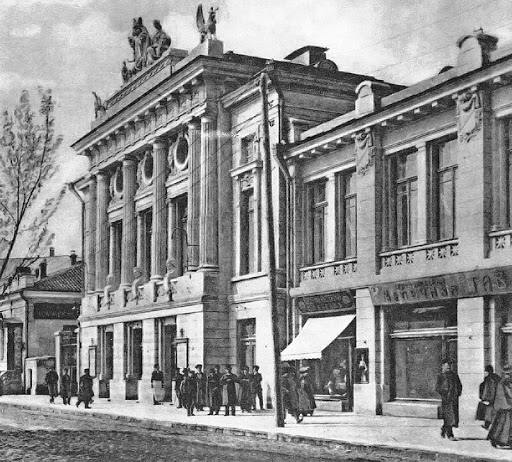
In previous publications, there have often been mentions of the tendency of certain individuals and biased groups to start the history of Crimean Ukrainians either from 1954 (when Crimea was incorporated into the Ukrainian SSR) or from 1991 (since Ukraine gained independence), while claiming that Ukrainian culture is completely foreign to the peninsula. However, undeniable historical facts prove that the presence of the Ukrainian people in Crimea dates back much earlier. This also applies to Ukrainian theater in Crimea, the origins of which can be traced back at least to the beginning of the Crimean War. Much information about its formation and development has been left by the scholars of the Tavria National University named after V.I. Vernadsky, including Petro Kyrychok, Hennadiy Mykhailychenko, and Oleksa Nyryko (unfortunately, they are no longer with us), as well as Petro Volvach and other researchers of the history of Ukraine on the peninsula.
In 1842, the entrepreneur and actor Danylo Zhurakhivskyi built the first stone theater building in Sevastopol, where a Ukrainian-Russian troupe performed, touring not only Crimea but also southern mainland Ukraine. In 1881, the Sevastopol amateur theatrical group was led by L.Y. Rozumny, a court official, who organized family-dramatic evenings in the city assembly during the 1882-1884 seasons, featuring the best works of Ukrainian playwrights in the repertoire. At the same time, reports appeared in Ukrainian newspapers about the group of Ukrainian theater enthusiasts in Sevastopol, led by Tokarsky and Pronsky, which consisted of about 30 people of different nationalities, as well as the tours of Ukrainian theater troupes in the city. At the end of the 19th century, an amateur theatrical group of artisans was formed in Sevastopol, led by the local figure Pallias, with many Ukrainian dramas in its repertoire. An Ukrainian troupe also operated in the city at the railway station under the direction of M. Dyachenko.
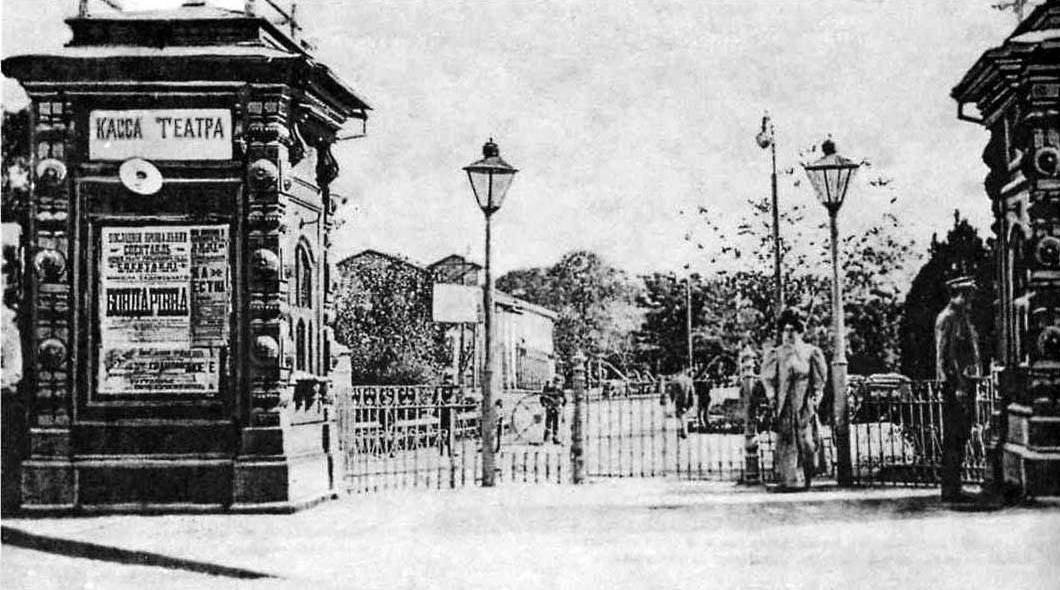
After L. Rozumnyi’s death, the dramatic group at the People’s House in Sevastopol was led by naval engineer Oleksandr Kovalenko, a Ukrainian public and political figure and co-founder of the RUP. Kovalenko and his colleague Levko Matsievych, under the pseudonyms “Zhurbenko” and “Mova,” became directors of the group. The amateur movement in Sevastopol was coordinated by the St. Petersburg Society named after Taras Shevchenko. The group’s performances were extremely successful, both among the local intelligentsia and the commoners: the demand for tickets was so high that audiences were willing to pay up to five times the regular price. In 1901, a covert Ukrainian organization emerged from the group, whose members established branches among the port workers and other government employees, as well as sailors and soldiers of the Sevastopol garrison, later contributing to the Ukrainianization of the local military units. In 1905, the Sevastopol group submitted a report to a commission formed to eliminate the censorship of printed works in the Russian Empire. However, on the eve of World War I, the press noted that in Sevastopol, “there are many Ukrainians, but until recently, they had not united.” Nevertheless, during the national liberation struggle, a Ukrainian club was established in the city.
In the 1860s-70s, in Yalta, the famous literary and public figure Stepan Rudansky supported local amateur artistic groups that staged plays by Ukrainian authors. The further development of theatrical life in Crimea was influenced by the visits of the greats of Ukrainian theater to the peninsula. In the 1870s-1890s, the region successfully hosted tours of Ukrainian theater figures, both with their own troupes and as part of other groups, including the “father” of Ukrainian theater, Marko Kropyvnytsky, Mykhailo Starytsky, Mykola Sadovsky, Panas Saksahansky, Ivan Karpenko-Kary, and Maria Zankovetska, who assisted in the creative development of Crimean amateur actors, among other stars of the Ukrainian stage. The local press always gave favorable reviews of these performances, describing the incredible reception of the performers by Crimean audiences.
In particular, the plays of Ivan Karpenko-Kary were actively used in the repertoire of local amateurs, especially the “Society of Little Russian Actors” under the leadership of Petro Natsilevych, which existed from 1905 to 1918, performing in Yalta, Alupka, and Gurzuf, and laid a strong foundation for the creation of a professional Ukrainian troupe in 1922 (led by Pavlo Deliavskyi, which self-dissolved in 1927 due to the indifference of the local authorities). By the way, one of the troupe’s actors was Alexander Horsky, the father of Alla Horska, the Ukrainian artist and dissident. Based on this troupe, the Ukrainian amateur drama and choral theater was founded, which in 1942, by order of the occupying authorities, went to Germany to service the slave labor camps, was named “Yalta,” and ceased its activities abroad at the end of World War II.
It is also worth mentioning the “Yalta Society of Little Russian Amateur Actors,” led by I. Pank and M. Al’bikovsky, which was founded in 1909. Since the end of the 19th century, a choir and drama group under the leadership of Pavlo Voskovy worked in Masandra, performing Ukrainian folk songs and choral works by Ukrainian composers. In Livadia, there was a Ukrainian drama and choral group led by M. Kupchenko. An amateur group with a Ukrainian repertoire also operated in Alushta. In Feodosia, Ukrainian theatrical societies operated under the leadership of local cultural figures Valentyn Viychenko and Ivan Dvornychenko. In 1906, the “Circle of Dramatic Art Fans” and a cultural-educational society were founded by the writer, poet, and playwright Mytrofan Korol in his native Armyansk.
An amateur theatrical group, led by director Kotov, organized popular family-dramatic evenings on the stage of the city assembly in Simferopol during the 1880s and 1890s, where Ukrainian performances were particularly successful. During the holidays, performances, including Ukrainian ones, were organized by the gymnasium students of Simferopol. Amateur groups staging Ukrainian dramas were also created in military units. In 1900-1901, the “Ukrainian Circle of Amateur Stage Art” was formed in Simferopol, gaining the support of the city’s “Committee for the Care of Public Temperance.” The group was led by director Shcherbyna, who had already dedicated over 10 years to Ukrainian theater, having been the director of Starytsky’s troupe and, at that time, worked as a government official in the Simferopol Control Chamber. The activation and growth of the amateur movement in Simferopol led to the founding of a Ukrainian club, which became the center for amateur activities, staging the best and most popular works of Ukrainian classical dramaturgy. Research mentions that at the same time, an amateur Ukrainian troupe was created in the city under the leadership of the land surveyor Pszeborovsky. Comparing the data suggests that these were likely the same group.
At the beginning of the 20th century, the Ukrainian dramatic society, led by Stepan Glazunenko (Glazunov), a comedic actor and director, a student of Marko Kropyvnytsky, toured Crimea. Critics were not always supportive of this group or Glazunenko himself, but it was largely thanks to his wife and her involvement in the troupe that the talent of a girl from Balaklava, Ksenia Borodavkina, was discovered. Ukraine and the world would later come to know her as the outstanding singer Oksana Petrusenko.
It is also worth noting that during this time, Crimean printing houses published some theater posters and programs in Ukrainian. Local and mainland playwrights’ works, such as those by Fedir Synitsyn, Vitaliy Tovstonis, and others, were also printed on the peninsula.
At the end of the summer of 1918, on the initiative of the Simferopol Ukrainian community, a congress of Ukrainian organizations in Crimea took place, with delegates from various parts of the peninsula attending. Among other decisions, it was resolved to establish a national theater. However, the Bolshevik occupation made its relentless corrections: at the beginning of 1926, members of the Ukrainian dramatic group in Sevastopol issued an open letter about the persecution of Ukrainian-speaking individuals. Nevertheless, in 1927 in Simferopol, a Ukrainian club, which had dramatic, choral, dance, and kobzar sections, was opened and worked successfully until World War II.
In the spring of 1942, one of the Crimean mobile groups of the OUN (Organization of Ukrainian Nationalists), to cover its activities and assist the local Ukrainian population, created two legal organizations—a bandura ensemble and a consumer cooperative called “Ukrainian Konsum.” Soon after, the Ukrainian Music and Drama Theater named after Shevchenko was established based on the ensemble. The theater, which numbered about 60 people, was led by director Mr. Petrenko and conductor N. Orlyansky and performed in Simferopol, Sevastopol, Dzhankoy, and Yalta. On June 2, 1942, the premiere of the first performance for the civilian population, “Zaporozhets za Dunayem” (The Cossack beyond the Danube), took place at the Simferopol City Theater.
“Just as in all of Ukraine, in Crimea, Ukrainian cultural and national life begins to be revived, freed from Bolshevik oppression. Deprived of any defense under the Bolshevik regime, the Ukrainians of Crimea had to endure the full force of the Russification frenzy from Moscow. It must, unfortunately, be stated that Russification made significant advances in Crimea. The sad reputation of the ‘Soviet man’ did not fade here, and therefore, we must highlight all those conscious individuals who, despite the unfavorable conditions, enthusiastically set to work on rebuilding Ukrainian cultural life. The very fact that a permanent Ukrainian theater was re-established in Simferopol after a 22-year break since 1918 is a testament to the resilience of the Ukrainians in Crimea, who did not succumb even to the harshest blows of fate,” wrote a Crimean correspondent. However, the German occupation authorities began to obstruct the theater’s activities, and by the fall of 1943, the theater was closed.
The inclusion of Crimea into the Ukrainian SSR necessitated the spread of Ukrainian culture in the region. On June 15, 1955, the Crimean Regional Mobile Theater opened its first season. It was established by the Presidium of the Supreme Soviet of the Ukrainian SSR on December 20, 1954, based on the Third Kyiv Regional Mobile Drama Theater, which had been transferred to the peninsula. Later, it was reorganized into a stationary Crimean Regional Ukrainian Music and Drama Theater, which eventually became the Crimean Academic Ukrainian Music and Drama Theater. This change in status allowed the troupe to expand and diversify its repertoire, which, in the first years of its existence, prominently featured performances based on the works of M. Starytsky, M. Kropyvnytsky, I. Karpenko-Kary, and other outstanding Ukrainian playwrights. In particular, the productions of “Marusia Bohuslavka” by M. Starytsky in 1958 and “Tytaryvna” by M. Kropyvnytsky in 1964 became some of the brightest performances in the theater’s history. The latter, dedicated to the 150th anniversary of the birth of T. Shevchenko, the theater troupe received a commemorative Shevchenko medal. Many of the theater’s productions have been repeatedly recognized with Republican awards.
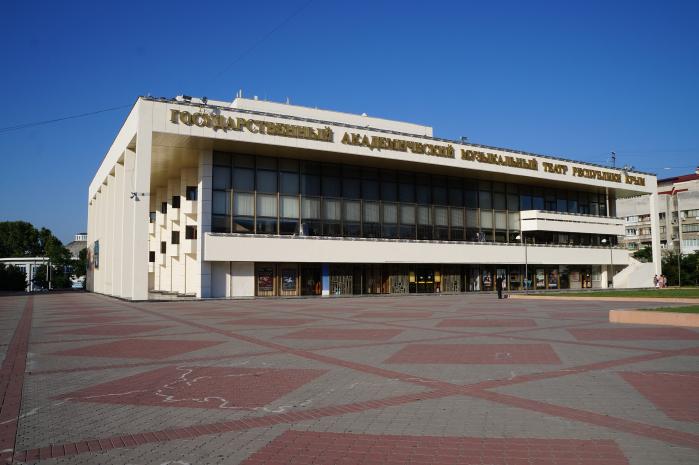
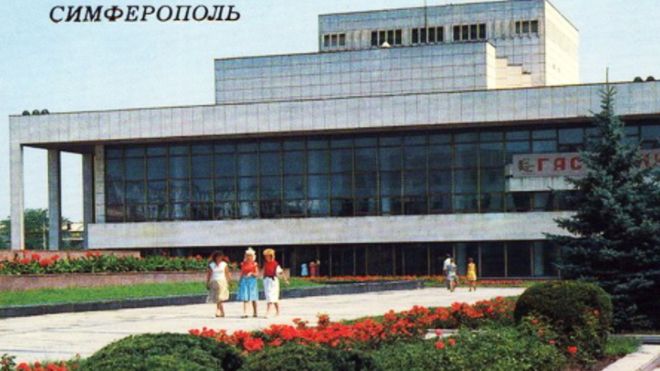
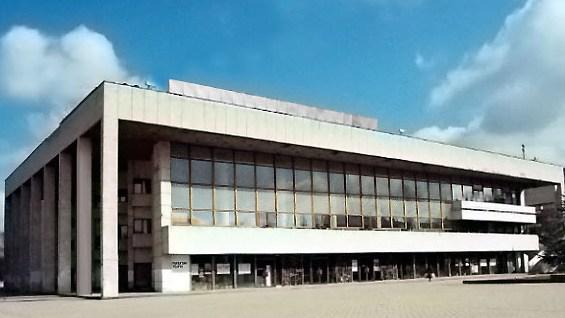
From 1955 to 1977, the Ukrainian theater was located in Simferopol at 3 Mendeleyev Street, where the House of Culture of the regional Ministry of Internal Affairs had previously existed. The theater building, constructed in 1977 on Lenin Square, was considered the best music theater building in Ukraine at the time.
In 1980, the theater became known as the Crimean Ukrainian Drama and Musical Comedy Theater. This transformation significantly improved the quality of productions and contributed to attracting new audiences to the theater. In 1991, the name was shortened to the Crimean Ukrainian Music Theater. In 2006, the title “Academic” was added to the theater’s name.
Throughout its history, spanning more than half a century, the theater changed its status many times. At the dawn of Ukraine’s independence, as part of the effort to suppress the Ukrainian presence in Crimea, the Ukrainian theater was essentially transformed from a dramatic theater into an operetta theater. In the 2000s, the repertoire of theaters in Crimea was composed of half Western European drama, half Russian works, and some Ukrainian plays. For the Ukrainian Music Theater, more than half of its repertoire could consist of Western European texts, more than a quarter of productions based on Russian drama, and only about 10% on Ukrainian works.
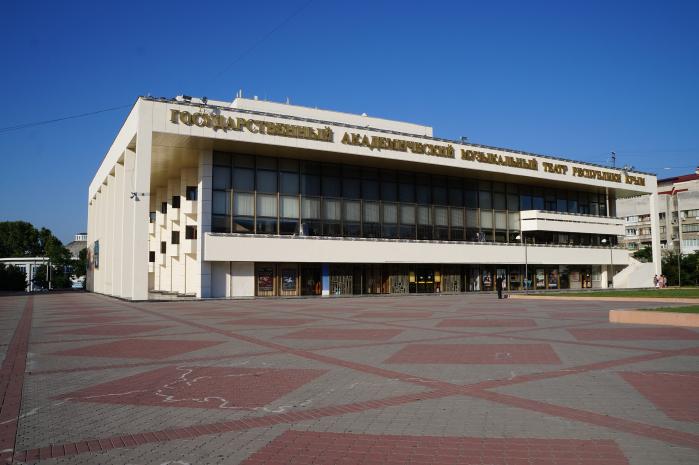
In the early 2010s, it was claimed that the Ukrainian theater in Crimea was practically nonexistent; sometimes its repertoire didn’t even hint at the theater being Ukrainian. “De jure Ukrainian, de facto Russian, even Soviet,” local cultural figures lamented, noting that the theater had become a hostage to political games and “was even becoming aggressively anti-Ukrainian, as no Ukrainian word was heard from the stage anymore.” It was even suggested that the theater with the “Ukrainian” sign in Crimea had been created to perpetually prove that there was no such thing as Ukrainian art and that what is Ukrainian is “Russian, but much worse.” Specifically, during the presidency of Viktor Yanukovych, the Ministry of Culture of the Autonomous Republic of Crimea transferred the theater’s property and financial problems to its staff, with a deliberate reduction in the workforce. The situation was somewhat alleviated by the fact that, at that time, the theater was the only stage in Simferopol that met the requirements for touring performances.
Given this, it was not so much the constant fairs and sales that took place in the theater lobby that attracted attention. The situation inevitably sparked a public reaction; in particular, protests were held demanding that the theater’s management include Ukrainian-language productions in its repertoire. In November 2011, public organizations from the peninsula sent an open letter to the Minister of Culture of the Autonomous Republic of Crimea, stating that the Crimean Academic Ukrainian Theater was not living up to its status and was failing to fulfill its tasks in the areas of statehood development and Ukrainian art. The letter was signed by the heads of the public organizations “Ukrainian Community of Crimea” and “Center for Cultural Development and Science ‘Ukrainian'”House'”—Vladyslav Khmelovsky (who has sadly passed away) and Andriy Shchekun, as well as the heads of the Crimean branch of the Shevchenko National Scientific Society and the All-Crimean Society “Prosvita,” named after Taras Shevchenko, Petro Volvach, and Serhiy Savchenko. Every year, the Ukrainian community of Crimea raised the issue of the proper performance of duties by the theater’s leadership. Often, Ukrainian culture appeared on the theater stage “not thanks to, but in spite of” the circumstances. Notably, the production of “Lies” by Volodymyr Vynnychenko, directed by Professor Viktor Humenyuk, head of the Ukrainian literature department at the Taurida National University named after V.I. Vernadsky, who also served as the director and literary manager of the Crimean Academic Ukrainian Music Theater, became a significant event. This premiere attracted almost the entire intellectual elite of Ukraine.
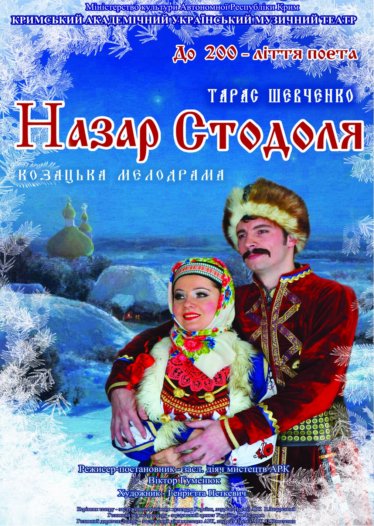
After the Russian occupation of Crimea, in November 2014, the self-proclaimed “authorities” gave the theater a “gift” for its 60th anniversary season—they removed the word “Ukrainian” from the name of the local theater. From that point, it became the “State Academic Musical Theater of the Republic of Crimea.” As the theater’s director at the time, Volodymyr Kosov, stated, the new name “fully justifies itself,” because “ethnic affiliation should not determine the direction of the theater’s work.” No Ukrainian-language performances were included in the repertoire, although, as late as March 2014, during the occupation, the theater had staged the premiere of “Nazar Stodolia” to mark the 200th anniversary of Taras Shevchenko.
Serhiy Konashevych
Author of numerous cultural publications, Public House “Ukrainian Culture” Ltd. editor
Translated by Viktoriya Kvitsynska
If you have found a spelling error, please, notify us by selecting that text and pressing Ctrl+Enter.