

- Ця сторінка також доступна на
 Українська
On June 5–10, 1917, the Second All-Ukrainian Military Congress was held, according to the decision of which the Sevastopol Ukrainian Council of Military and Workers’ Deputies [SUC] was established in Sevastopol, headed by warrant officer Kostyantyn Velychko. In addition to this organization, the interests of the Sevastopol Ukrainian community in the conditions of growing anarchy were protected by the Black Sea Ukrainian Military Committee and the Ukrainian faction of the Sevastopol, which the Bolsheviks tried to take control of as quickly as possible. SUC demanded the Ukrainianization of the Black Sea Fleet and its subordination to the Ukrainian Central Council [UCC], promoting and supporting the relevant processes.
SUC had its own newspaper, “Bulletin of the Ukrainian Council of Military and Workers’ Deputies of the City of Sevastopol”, which was published mostly in Russian, but it provided news and official messages from Kyiv in Ukrainian, and even then not always. SUC and the editorial office of its bulletin were located in building No. 33 on Nakhimovsky Avenue. The paper came out from the printing house of the former editor-publisher of the local newspaper “Krymskiy Vestnik” (Crimean Bulletin), Odessa Burgher Isaac Neuman.
Unfortunately, only two copies of the “Bulletin” were found in the archives of the capital of Ukraine. However, they provide some evidence about the socio-political life of Ukrainians in Sevastopol in late 1917 and early 1918.
In No. 4 of the “Bulletin” for December 22, 1917 (the date is obviously given in the old style), was posted an appeal from the Commission of the Black Sea Naval District on elections to the Constituent Assembly of the Ukrainian People’s Republic [UPR]. The task of this elected legislative institution was to approve a new order and establish the constitution of the Ukrainian state. According to the III Universal, the election day was set for January 9, and the convocation day was set for January 22, 1918. However, in the conditions of Bolshevik aggression against the UPR, the Constituent Assembly was not convened.
The commission’s appeal stated that Ukraine includes: “The provinces of Volyn, Katerynoslav, Kyiv, Poltava, Podolsk, Kharkiv with the annexation of the Grayvoronsky district of the Kursk province; Kherson, Chernihiv with the annexation of the Putyvl district of the Kursk province; Ostrogozhsky, Valuysky, Biryuchensky, and Bogucharsky counties of Voronezh province; and Novooskolsky county of Kursk province; and Tavria Province, which includes Berdyansk, Dnipro, and Melitopol counties.” To hold elections at the front, 5 front-line electoral districts were established: Northern (with troops stationed in Finland and subordinate to the commander of the Baltic Fleet), districts of the Western, Northwestern, Romanian, and Caucasian fronts.
To hold elections in the fleet, 2 districts were established: the Black Sea and the Baltic, which consisted of “ship commands, coastal commands, as well as those serving fleet commanders.” In these two districts, voting for special candidate lists could be attended by “military personnel belonging to military units or serving in the troops; persons of both sexes serving in the troops, ship commands, and coastal units of the Black Sea and Baltic fleets and who have reached the age of 20; ranking civil servants; clergy of all faiths; other employees, even freelancers, including workers in various parts of the military administration.” It was noted that persons under the age of 20 also had the right to vote, but only if they were in active military service. The commission also urged all units of the fleet and the garrisons of Sevastopol and Balaklava to hurry up and submit electoral lists of all citizens of the UPR in two copies, indicating the province and county of each, no later than December 23, 1917 (probably according to the old style). Secretary Rybka signed on behalf of the Election Commissioner. It was not possible to find out the name of the commissioner himself because, unfortunately, the page of the archival copy was frayed at this point. Most likely, it was Yuriy (Georgy) Dezhur (Zhurov), a member of the UCC from Crimea; it was he who was contacted by telegraph in early January 1918 by the head of the Ukrainian Community of the Southern Coast of Crimea, Pavlo Horyansky, informing about the compilation of voter lists. In Crimea, elections were held only elsewhere, due to terror and arrests by radical leftist forces with the support of sailors from the Black Sea Fleet. On January 29, Horyansky reported to Sevastopol that the elections would be held on February 2-4, despite the fact that in Yalta, which was changing hands, the “dictatorship of the proletariat” was established on January 16. In the end, as on the entire peninsula.
In No. 2 of the “Bulletin” for January 5, 1918 (the date is also probably given in the old style), an appeal to “comrade Ukrainian sailors” was printed, signed “E. S.” (the cryptonym could not be deciphered), the abridged text of which is given below.
“…Right now, you are in a wide field where every man and his dog are sowing their disgusting seed, setting you against your parents and brothers. Think about it and use your common sense to figure out where you are being called and what kind of dirt your imaginary well-wishers are pouring on your parents and brothers. We are all so crippled by the old regime that we don’t know ourselves—we don’t know what nationality we are and what our history is. We were told that we were “khokhols” and, at best, “little Russians.” The word “Ukrainian” could not be pronounced, because anyone who pronounced or wrote it was arrested by gendarmes and convicted as a revolutionary (and as a counter-revolutionary for the same reason now). A coup took place. We, Ukrainians, declared that this revolution should liberate both the oppressed class of working people and the nations that were oppressed under tsarism. We resolutely declared that we are no longer “khokhols” or “little Russians,” but Ukrainians, who have their own history, territory, language, and customs, and that this gives us the right to the sovereign existence of a nation and state. For this, we were accused of pursuing our policy in the interests of Germany that all this was being done with German money. This was said and written by the “Little Russian” bourgeoisie, and the Russian socialists—revolutionaries and Mensheviks—helped them in this. The Bolsheviks were silent, or they praised the Ukrainian Council. We, Ukrainians, who wish well for our oppressed peasantry and proletariat, did our job—organized this oppressed class around Ukrainian socialist parties…
…I ask comrades Bolsheviks of Ukrainian origin: do you recognize the Ukrainian nation? And if you do, why do you call yourself not the Ukrainian but the Russian Social Democratic Workers’ Party of the Bolsheviks? If I am told that this party is international, then why does it have the name Russian and not just a party? Therefore, if it can bear the name of a Russian party, then with the same success a German Bolshevik party can exist, an English one, etc., etc., and hence the final conclusion that there can also be a Ukrainian Bolshevik party. While I welcome any socialist party, as long as it does not turn into a monster, I will especially welcome the Bolsheviks of Ukrainian origin when they show their national face and stop calling themselves the Russian Social Democratic Revolutionary Party. Comrade Bolsheviks of Ukrainian origin, become Ukrainian Bolsheviks and take up the state building of your nation yourself, and then you will see better where the bourgeois are and where your well-wishers are. If you do not take up this task, as befits socialists, then it will be a crime to destroy, with the help of our Russian comrades, what was created in Ukraine with such difficulty by your fathers and brothers.
I draw your attention to the following: what has the revolution in Sevastopol brought us, Ukrainians? And here it is: We all know that former Lieutenant Blahovishchensky was tried by revolutionary democracy, represented by a revolutionary tribunal, only because he was Ukrainian. But this is not convincing to you because Blahovishchensky is an officer and therefore a bourgeois and a counter-revolutionary, although no such accusation was made, and Blahovishchensky recognized himself as a Ukrainian not yesterday but back when the Bolsheviks were praising Ukrainians and their Council…
So come to your senses, comrades, and start working for your happiness, because the time may come when you too will be judged for daring to call yourselves Ukrainians…”
However, to great regret, these calls did not achieve the desired result.
Since mid-December 1917, arbitrary “revolutionary trials” were held in Sevastopol, the consequences of which were mass executions of army and navy officers. In early January 1918, a “campaign against the Tatars” was carried out, which eyewitnesses called “a brilliant victory of the Soviet gang over the peaceful Tatar people” (in particular, Soviet historiography mentions the defeat of “gangs of Tatar nationalists” by Red Guards and sailors in Feodosia, Yevpatoria, and near Sevastopol). At the same time, a rally of sailors, soldiers, and port workers was held in Sevastopol, the resolution of which stated: “We brand the Ukrainian Council in Kyiv and its general secretaries-compromisers with shame, together with the bourgeoisie and the Kaledinians, who put a noose around the crippled necks of the peasants and workers. Down with the compromisers! Don’t count on the Black Sea Fleet, because we will be the first to point 12-inch guns at you.” On January 20, the Bolshefied Executive Committee of the Sevastopol Council of Military and Workers’ Deputies [Sevastopol Soviet] and Centroflot adopted a resolution at a joint meeting on the non-recognition of the “counter-revolutionary” UCC. SUC, in turn, did not recognize the Bolshevik government but refrained from active speeches. On January 26, the executioner of Ukraine, People’s Commissar Vladimir Antonov-Ovseyenko, telegraphed from Kharkiv: “The Soviet government triumphed in Sevastopol. All ships switched to its side. The Council (probably SUC – S. K.) was dispersed.”
On February 2, the heads of the Sevastopol Soviet and the Centroflot, M. Pozharov and S. Romanovsky, sent a telegram to the Council of People’s Commissars in Petrograd (copies were sent to Kyiv, Kharkov, etc.), assuring that the Black Sea Fleet recognizes only the central government represented by this council as the “sole expression of the will of the working people,” and in Ukraine, only the “government of the working people” represented by the puppet Kharkov All-Ukrainian Executive Committee. Black Sea Fleet units declared to the UCC that they would not carry out its orders and regulations. On February 9, by signing the Brest Peace Treaty with Germany, the UCC voluntarily renounced Crimea as Ukrainian territory. The government of Hetman Pavlo Skoropadsky will take on the task of correcting this mistake in a few months.
In mid-February, pep talks were heard in Sevastopol about the need to destroy the intellectuals and the bourgeoisie, about the triumph of the proletariat, etc. Soon terror spread in the city, provoked by unrest among the sailors, who decided to “force the bourgeoisie to lower their heads, raised under the influence of German successes at the front” (at that time, the German army began its offensive on the Eastern Front, which had been devastated by demobilization). The Central Committee of the Sevastopol Soviet knew nothing about this, and when received a report about the gathering of 2,500-3,000 armed sailors at Stone Pier, who did not want to listen to anyone and acted at their own peril and risk, decided to stop this and sent two representatives to the rebels. In response, the sailors declared that the time for words is over—it’s time to destroy the “bourgeois” in the city; then they broke into separate groups and began mass arrests. On February 21, the Council of People’s Commissars issued Lenin’s decree “The Socialist Fatherland is in Danger!” which introduced the death penalty, which had been abolished by the Second All-Russian Congress of Soviets in October 1917. On the night of February 23 alone, according to recorded testimonies, 250 people were killed in Sevastopol who were inhumanly tortured by the executioners before their deaths; among the victims were, in particular, the Crimean Tatar spiritual and political figure Noman Chelebidzhikhan and the Sevastopol artist of Karaite origin, Mykhail Kazas.
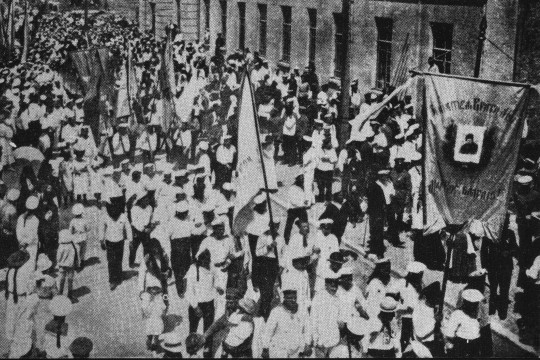
In the morning, the Central Committee allowed a blasphemous procession to be held in Sevastopol under the slogan “All power to the Soviets,” which took place to the solemn musical accompaniment of an orchestra. In order to stop the arbitrary searches, detachments headed by commissars were organized to conduct searches and seize valuables. According to historical evidence, the slogans of the “dictatorship of the proletariat” did not meet with the support of the majority of the population but were imposed by force of arms.
Illustration / Destroyer “Zavydny” that has got the influential Ukrainian council
Similar actions took place in Simferopol, where 170 people were shot on the night of February 24, and in Yevpatoria, where secret executions took place on March 2. Calls for mob rule were heard in Alushta and Yalta. The mass massacre in Sevastopol was put to an end by workers who formed effective self-defense units; after that, they demanded re-election of the Bolshefied city council, whose leadership, although it publicly condemned the crime, did nothing to punish the perpetrators—except for removing Romanovsky, the head of Centroflot, from his post. For a long time, storms continued to wash corpses ashore.
At the end of April 1918, Crimea was liberated from the Bolsheviks by German and Ukrainian troops, who were welcomed by the local population as liberators. At the same time, Ukrainian flags fluttered over Sevastopol and the ships of the Black Sea Fleet. However, unfortunately, not for long.
Serhiy Konashevych
Author of numerous cultural publications, Public House “Ukrainian Culture” Ltd. editor
Translated by Anton Bozhuk